As I get more inclined towards eye makeup I have always wondered about the colors that would complement me. As a beginner many of us might face the same challenges and it’s easy to get confused about the color that would suit our skin tone, eye color, hair color, color of the clothing and so on and so forth. The big question always lingers-What are the right colors?”. This is where the Color Wheel comes to our rescue!!
The color wheel is an organization of colors put together in a circle showing the relationship between colors. The colors in the wheel consist of Primary colors, secondary colors, tertiary colors and also depict the inter-relationship between them (complementary colors, analogous colors etc). We can look at the relationships between various colors in the color wheel and apply them to find the right colors for our eye makeup, clothes, concealers and what not!!

Color Wheel 1
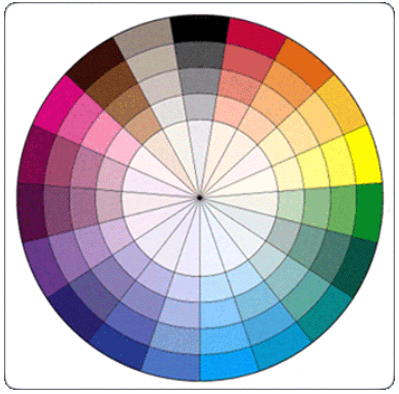
Color Wheel 2
PRIMARY COLORS are Red, Yellow and Blue and are the basic building blocks of all colors. These 3 colors cant be made using other colors.
SECONDARY COLORS are made using the Primary Colors. For example Yellow(Pri)+Blue(Pri)=Green(Sec).
TERTIARY COLORS are made using one primary color and one secondary color. For example Violet(Sec)+Red(Pri) = Violet-Red(Ter).
Now lets talk about the relationships that exist between these colors and how we can implement various color schemes into our makeup regime!!!
1. COMPLEMENTARY COLORS: Colors directly across from each other are called complementary colors . When placed to each other they “complement” each other or contrast each other and make each other vibrant. You choose the complementary color to your eye color as your eye shadow color. However you must exercise caution while using the complementary colors in full intensity and it must be managed well so that it is not jarring.
 | |
Blue Eyes: Blue-eyed people can use orange eye shadows to complement their eye color. If orange seems too garish then use eye shadows with undertones of that color. For example a bronze or copper eye shadow may have undertones of orange and thus can be used by blue eyed people.
Green Eyes: Green eyed people can use a pink eye shadow (which is the red family).
Brown Eyes: Brown eyed people would have either yellow undertones or orange undertones. So you can use complementary color of yellow (which is violet) or orange (which is blue) as your eye shadow color.
Black Eyes: For people with black eyes refer to the 2nd color wheel. You can choose blue as your eye shadow color or use a color with blue undertones like Teal.
2. ANALOGOUS COLORS: Colors that lie on either side of any given color are analogous colors or we could say that any group of colors that lie next to each other are analogous. For example green, yellow-green, and blue-green are analogous and can be paired together. Analogous colors are subtle and will blend into each other.

Blue Eyes: If you have blue eyes then you could choose the following combinations:
Orange, red-orange and red--OR--
Orange, Yellow-orange and Yellow
--OR--
Orange, Red-orange and Orange-Yellow
Green Eyes: If you have green eyes then you could choose the following combinations:
Red, Violet-red, Violet
--OR--
Red, Red-orange, Orange
--OR--
Red, Red-Orange, Violet-Red
Brown Eyes-Orange Based: For orange based Brown eyes you may choose the following combinations:
Blue, Blue-green, Green
--OR--
Blue, Blue-violet, Violet
--OR--
Blue, Blue-green, Blue-violet
Brown Eyes-Yellow Based: For yellow based Brown eyes you may choose the following combinations:
Violet, Blue-violet, Blue
--OR--
Violet, Violet-red, Red
--OR--
Violet, Blue-Violet, Violet-red
Black Eyes: If you have black eyes then you could refer color wheel 2 to refer to the combinations.
3. SPLIT COMPLEMENTARY: Split complementary is a base color, its complementary color and the two colors adjacent to its complement color. In the color wheel the split complementary colors would be on the either side of the complementary color. For example the split complementary color for Green is Red-orange and Violet-red. 
So your eye shadow color can go beyond just the complementary colors to split complementary colors.
Blue Eyes: The eye shadow color could be the split complementary colors of blue which are yellow orange and red orange.
Green Eyes: The eye shadow color could be the split complementary colors of green which are red-violet and Red-orange.
Brown Eyes-Orange Based: The eye shadow color could be the split complementary colors of orange which are Blue- green and Blue-violet.
Brown Eyes-Yellow Based: The eye shadow color could be the split complementary colors of Yellow which are Blue-violet and Red-violet.
Black Eyes: Refer to the 2nd Color Wheel.
4. TRIAD COLORS : Triad colors are three colors equidistant on the color wheel (for example you can take a basic color like green, take the complementary color which is red and then go 2 to the right or 2 to the left).

Triad colors make the colors appear fun and vibrant. So if you have a orange colored dress then you can make it vibrant using Violet or green based makeup. Or you could start with the color of your eyes and choose the triad colors as your fun eyeshadow shade.
Color Wheel and choosing the right Concealer:
When complementary colors are put next to each other they make each other vibrant and when they are placed on top of each other they neutralize each other and thus may be used for camouflaging. For example if you have a red colored zit that has to be covered then use a concealer with green undertones. For dark circles, if you have purple colored dark circles around the eyes then a yellow based concealer is going to camouflage the imperfection. If the dark circles are more of blue in color then a orange based concealer will neutralize it.
You can get the color wheel at any art/craft store or try it out at amazon.com. So Ladies...play with the colors and look beautiful!!!
Disclaimer: The Images used are from the following websites
http://fashionbombdaily.com/wp-content/uploads/2010/01/ColorWheel1.jpg


